A system that distinguishes between solid ground and open reading. This
document presents the problem it solves, how its architecture works,
the evidence that it works, and why the right solution
for humanities is not the same as for sciences.
Updated 22.03.2026 · State of the art and bibliographic findings cross-checked with Scite Smart Citations
Dicendum est, sed ita ut nihil affirmem, quaeram omnia,
dubitans plerumque et mihi diffidens
"I must speak, but without affirming anything; I shall investigate everything,
doubting most of the time and distrusting
myself."1
1Marcus Tullius Cicero, De divinatione,
II, 3, 8, citado en Michel de Montaigne,
Los ensayos (ed. 1595), trad. J. Bayod Brau
(Barcelona: Acantilado, 2007), 587.
§ 01 — The documented problem
Leading LLMs keep failing at citation verification
PaperAsk (arXiv, Oct 2025) evaluated GPT-4o, GPT-5, and Gemini-2.5-Flash
on real-world academic tasks. Not just in controlled benchmarks,
but under real working conditions.
48–98%
Failure rate in citation retrieval with
multi-reference queries
PaperAsk · citation retrieval task
72–91%
Failure in content extraction by
section
PaperAsk · content extraction task
<0.32
F1 in paper discovery — over 60% of
relevant papers are missed
PaperAsk · paper discovery task
Citation retrieval (worst case)
98% failure
Citation retrieval (best case)
48% failure
Content extraction
72–91% failure
AstaBench — mean accuracy (57 agents)
38.78%
Reliability is not assumed — it is designed. These data
are not anecdote — they are published and reproducible benchmarks on the
best available models under real conditions. The problem is
structural.
§ 02 — Definition
What is Ateneo
An AI-assisted editorial research instrument that
distinguishes between solid ground and open reading. Not a chatbot. Not
a wrapper. An architecture designed so that every claim
has an explicit confidence level.
Level
Mode
Nature
Function
Solid ground
CITA
Deterministic, no LLM
Verifiable literal citability. Pure documentary search with
cache. The reader can go to the text and judge for themselves.
Open but verifiable interpretation. Guardrails + gap detection
+ auditing. It does not hallucinate — it rereads.
In Lacan we are not looking for a certainty machine, but a system that
distinguishes between verifiable citation and anchored assisted reading. Ateneo
does not repeat — it rereads. And it does so anchored in the text.
Master Context · Ateneo · 2026
Diagrams
Two interactive diagrams to read Ateneo's architecture
at a glance before entering the technical layers.
An LLM is a probabilistic generator: it produces fluent text, but does not
guarantee that text is faithful to the corpus. Ateneo interposes six
verification layers between the model and the user.
🚪
Pre-LLM
1. Whitelist — Only admitted evidence
The LLM never sees data from outside the curated corpus. Suspension of
all external judgment: "you can only speak about what is in these
books."
✂️
Post-LLM
2. stripDisallowedCitations — Sanitization
Reviews the model's output and strikes out any citation outside the
allowed list. "Meditations, Book XV" → does not exist (there are only 12).
Removed.
⚖️
Rule
3. Quote Contract — Explicit contract
Prompt with formal instruction: "If you cannot find the citation, say
you cannot find it. Do NOT invent." Sets the framework; if it fails,
layers 4–6 catch it.
🔍
Logic
4. Gap detection — Suspicious jumps
Detects unjustified temporal or conceptual jumps. Citation
from Seminar 2 (1955) alongside a reference to Seminar 20 (1972)
without explanation → alarm.
📁
Classification
5. ANCLA / NÚCLEO / VECINDAD / RUIDO
Each retrieved fragment is classified by proximity. Only
ANCHOR (exact citation) and CORE (immediate context) reach the LLM.
VICINITY and NOISE are discarded.
👥
Cross-check
6. Cross-validation — Consensus across sources
Cross-checks sources against each other. In Marcus Aurelius: 4 languages (Greek,
English, Spanish, French). If "confirmed" in English but without
a correlate in Greek → inconsistency.
§ 03b — Hybrid search
Three methods,
complementary coverage
Each search method has a different blind spot. Combined,
they compensate for each other.
🔍
Trigram (pg_trgm)
Form-based search
Divides text into 3-character chunks and compares. Tolerant of
typos and imperfect OCR.
✓ Detects typos, variants
✗ Does not understand meaning
🧠
Vector / HNSW
Meaning-based search
Each text → vector of 1,536 numbers. «The impediment to
action...» y «τὸ ἐμποδίζον τῇ πράξει...» → nearly identical
vectors.
✓ Crosses languages, synonyms
✗ Can confuse ambiguous concepts
📖
FTS (Full-Text Search)
Word-based search
Analytical index with morphological flexibility. "verificar"
finds "verificación" and "verificado".
✓ Morphological roots, precision
✗ Does not cross languages
4 formal contracts. 80 cases. 80/80 live. End-to-end runtime auditing.
The difference is not the system's volume, but its discipline:
verifiable contracts, checkers, CI, and traceability persistence
when the model responds.
§ 04 — Evidence of reality
Production, not prototype
Ateneo has been in production since February 2026 operating on real
humanities corpora. These are the verified metrics.
80/80
Static and live validation — 20 cases per mode, 4
modes, 0 failures in the current battery
CI · GitHub Actions · production
4
Formal contracts — CITA, FUENTE, MAPA and Stoic Verify
Contracts · Python checkers · CI
Runtime
Persisted auditing — claims, evidence, and policy snapshots
confirmed end-to-end
Production · per-response traceability
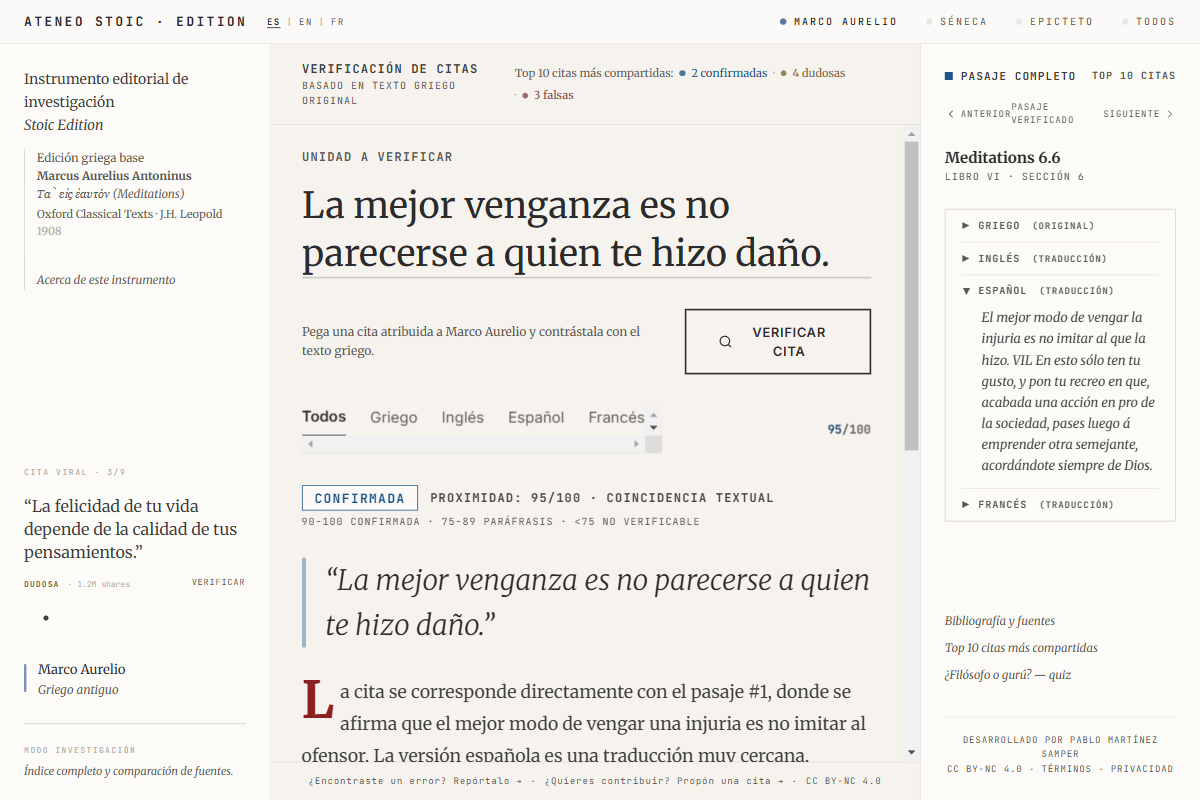
Ateneo Stoic Edition · Production verification · Citation cross-checked against original Greek text (Leopold 1908) in 4 languages
Curated corpus of Lacan's 23 Seminars. OCR corrected,
pagination aligned with Paidós editions. The hard case:
multiple editions, translations with variance, oral seminars
transcribed.
Marcus Aurelius + Seneca + Epictetus in 4 languages
Critical apparatus with original Greek text (Leopold 1908, Long
1862), English, Spanish, and French. Cross-verification across
four languages. Public domain editions with stable textual
tradition.
How do I know it doesn't invent citations? Three levels: (1)
citations [Book, p.N] are validated against the deterministic database
— if it didn't come from there, it is removed; (2) quoted literals are
verified character by character against original snippets; (3)
runtime auditing cross-checks languages to detect inconsistencies. The
cita_fast contract is 100% deterministic, no LLM.
§ 05 — State of the art
What the field proposes and what Ateneo has
Papers from the last 6 months on citation verification in LLMs,
cross-referenced against Ateneo's architecture.
FACTUM
Johns Hopkins / DARPA · ene 2026
Mechanistic theory: hallucination is an Attention vs
Feed-Forward failure in the LLM.
Provides theoretical framework for why Ateneo's guards work. Not
competition — justification.
Diagnostic
SemanticCite
U. Sydney · nov 2025
Verify whether the citation actually supports what is said,
not just whether it exists.
Attribution alignment con retrieval-augmented validation.
65,4% de precisión en CiteME
— casi a nivel humano (69,7%).
Ateneo follows this same scheme: retrieval → LLM → verification.
In specialized humanities, precision tends to drop due to
corpus complexity.
✅ Sí
CheckIfExist
— · ene 2026
Verify that bibliographic references actually exist
before including them.
stripDisallowedCitations: if the citation [SEM XI, p.N] did not
come from the DB, it is automatically removed.
✅ Sí
HalluCitation Matters
NAIST, Japón · 2025
Documents fabricated references in papers accepted at ACL, NAACL,
and EMNLP — top conferences.
The problem is so severe that it contaminates peer-reviewed
academic publications.
Diagnostic
Citation Failure / CITENTION
TU Darmstadt · sep 2025
Distinguishes citation failure (incomplete citation) from
response failure (incorrect response).
cita_fast: no response failure possible (deterministic).
FUENTE separates citation verification from response quality.
✅ Arq.
Deployment Constraints & Citation Hallucination
NYU / CMU / Boston U · mar 2026
Empirical study on how production prompting constraints aggravate citation hallucination, evaluated on Claude Sonnet, GPT-4o, LLaMA, and Qwen with a deterministic verification pipeline.
cita_fast is 100% deterministic and LLM-free: this is exactly what this paper demonstrates works. arXiv:2603.07287
✅ Sí
PaperAsk
arXiv · oct 2025
Quantitative benchmark: citation retrieval fails 48–98% on GPT-4o,
GPT-5, and Gemini.
Not anecdote but reproducible numbers on the best models under
real conditions.
Benchmark
OpenScholar
Allen Institute · 2024
Real system: scientific literature synthesis with RAG and anchored
citations. Paper in Nature, public demo.
Operates in STEM, not humanities. Single model (LLaMA 3.1 8B).
Product
VeriCite
arXiv · oct 2025
Pipeline: generation → evidence selection → refinement with
verified citations.
Prototype with no visible production deployment. Does not verify
interpretive prose between citations.
Prototype
4 of 9 papers describe mechanisms comparable to
components already implemented in Ateneo. The pending gap converges on
one point: that interpretive prose have visible grounding in the text.
That is precisely the territory where Ateneo is working.
Epistemological note: Quattrociocchi, Capraro, and Perc
(arXiv 2512.19466, with empirical validation in PNAS)
formalize this intuition under the concept of Epistemia:
LLMs are not epistemic agents but stochastic completion systems
where linguistic plausibility replaces epistemic
evaluation. Ateneo starts from the same premise: reliability
is not assumed from the model — it is designed into the contract, traceability, and
abstention.
§ 05b — Scite findings · March 2026
A territory still to be explored
A — Documentary gap
0
Papers on LLM citation verification in specialized humanities
corpora — across 280 million indexed sources
Adjacent work is beginning to appear — such as citation attribution
in novels (NAACL 2025, Michel et al.) — but the terrain of
verification for specialized humanities corpora
remains largely unoccupied.
Scite · 2 searches · March 10, 2026
B — SciRAG profiled
100% STEM
SciRAG (Nov 2025): operates on indexed scientific literature in
English with DOIs. Different domain from Ateneo.
DOI: 10.48550/arxiv.2511.14362
C — CiteGuard unrefuted
0
Contrasting citations in Scite for CiteGuard. The
65,4% en CiteME is the
best available STEM result.
Scite tally · March 10, 2026
Across 280 million indexed sources, I found no papers on
LLM citation verification in specialized humanities corpora.
There is adjacent work — citation attribution in novels is already at
top NLP conferences — but the central piece is missing: traceability and
explicit judgment about what can be cited and what cannot. That is
precisely the territory where Ateneo operates.
Scite Smart Citations search · March 12, 2026
Search updated March 12, 2026 — the gap in humanities corpora remains across 280M indexed sources.
§ 06 — Strategic relevance
Why humanities is the hard case
Most research on citation verification is
concentrated in STEM. Ateneo operates where that research has not yet
reached: specialized humanities corpora.
STEM — The easy case
Digital crutches available
Stable DOIs. Structured APIs (PubMed, Semantic Scholar).
Single-language corpus (English). Factual citations: "X causes Y."
Atomic verification possible and adequate.
Humanities — The hard case
No crutches, with constitutive complexity
Edition variants. Translations with editorial variance.
Disputed attribution. Oral circulation. And the fundamental point: in
humanities, citing already is interpreting.
What others do
Suppress the probabilistic
The defensive narrative: "we have mitigated hallucinations." It puts you in
the same race as everyone: who suppresses better what the LLM does
naturally. Race to the bottom.
What Ateneo does
Frame the probabilistic
What others try to suppress, Ateneo frames with real evidence.
The ground is hard. The reading is open but anchored. In
humanities, this is not a compromise — it is the right approach.
Academic backing · Scite, March 2026
Interpretation as a task,
not as a defect
Gadamer & Derrida · Utrecht U. · 2024 · Open Access
«Doing Justice to Poetry»
Formalizes in peer-reviewed literature the central thesis: in
humanities, interpretation cannot and should not be closed. DOI:
10.33391/jgjh.171
Openness as a task
Excerpts cited in Scite
"The task of philosophical hermeneutics is 'to leave the undecidable
undecided,' because 'no one knows, and no one has the power to
decide,' not even Gadamer."
The formula: Ateneo is not "an LLM we patched
to stop hallucinating." It is a reading device
where the deterministic (CITA, FUENTE) provides solid ground and the
probabilistic (MAPA) opens reading. The guardrails do not eliminate
probability — they frame it. The valuable thesis is not "we turned
the bug into the feature," but something more precise: we designed an
architecture adequate to the domain. Recent literature is beginning to
converge on the same point via another route: EviBound (arXiv 2511.05524)
demonstrates through autonomous agent governance that integrity does not
emerge from model size, but from explicit architectural
guards. Ateneo carries that same thesis into the editorial domain.
Who it serves today
Current use cases
Ateneo currently operates on two production corpora. These are the
profiles that already use it or that directly fit its
architecture.
Researchers and educators
Citation verification in curated corpora
A researcher who needs to check whether a Lacan citation
(Seminar, page, edition) is literal, approximate, or
nonexistent. Ateneo resolves it in seconds with full
traceability.
Publishers and critical edition projects
Quality control on manuscripts
An editor reviewing a manuscript with dozens of citations from
Marcus Aurelius' Meditations who needs to verify them against
multiple editions and languages. Ateneo cross-checks 4 languages
automatically.
Research centers and universities
Validation infrastructure for applied AI
A center that wants to integrate AI into its processes but needs
to guarantee that generated references are auditable. Ateneo's
architecture is portable to new corpora.
Technology transfer
Pilot on a specific corpus
An institutional or technology transfer partner who wants
to evaluate Ateneo on their own corpus: legal, philosophical,
philological, or textual heritage.
Next step
A concrete conversation
What we propose: a private 30-minute session
where we show Ateneo running live on the Lacan or
Stoic corpus. No slide decks — directly
on the tool. If there is a proprietary corpus on which to evaluate
portability, we can explore a scoped pilot.
Video call or in person. No commitment. The goal is for
the interlocutor to see the system operating and judge for themselves.
Exploration
Pilot on proprietary corpus
If there is a humanities or textual heritage corpus that
requires verification, we can jointly evaluate the technical
feasibility of a scoped adaptation.